



Nature
Nature refers to the natural world, emphasizing the diversity of living organisms, including people, and their interactions with each other and their environment. It is made up of four realms: land, ocean, freshwater and atmosphere. Although healthy ecosystems form the foundation of our societies and economies, these systems are increasingly under pressure.
Our economic stability heavily depends on nature, as more than half of global GDP relies on the ecosystem services that natural systems provide. Businesses face disruptions in supply chains, rising costs, and reduced resilience to environmental change. In response, regulators and investors are increasingly requiring companies to understand, manage, and disclose their nature-related impacts, dependencies, risks, and opportunities, as seen in frameworks such as TNFD and the CSRD.
Whether you are just beginning to explore your nature strategy or already have mature systems in place, at 2impact we work together with you to develop or strengthen your approach for achieving your ambitions. We help you translate nature-related dependencies, impacts, risks, and opportunities into practical actions grounded in recognised frameworks, enabling measurable progress and better-informed decision-making.
Nature Quick Scan & Awareness Session
If nature is a relatively new focus area for your organisation, a valuable first step is to raise internal awareness and explore what it means specifically for your sector. Our Nature Quick Scan & Awareness Session offers an ideal starting point to build understanding and spark dialogue.
During this session, we introduce what nature means in a business context and why it is increasingly relevant for your sector. We explain how organisations depend on and impact land, freshwater, ocean and atmosphere, and how these interactions can translate into operational, financial and regulatory risks.
Through a high-level screening of your operations and value chain, we identify potential areas of interaction with nature and highlight possible priority topics. We also provide insight into how peers are approaching nature-related challenges and outline relevant frameworks such as the Taskforce on Nature-related Financial Disclosures (TNFD), the Science Based Targets Network (SBTN) and the Corporate Sustainability Reporting Directive (CSRD).
The outcome is a concise overview of key focus areas and recommended next steps, providing clarity on whether a more in-depth Nature LEAP Assessment is appropriate.
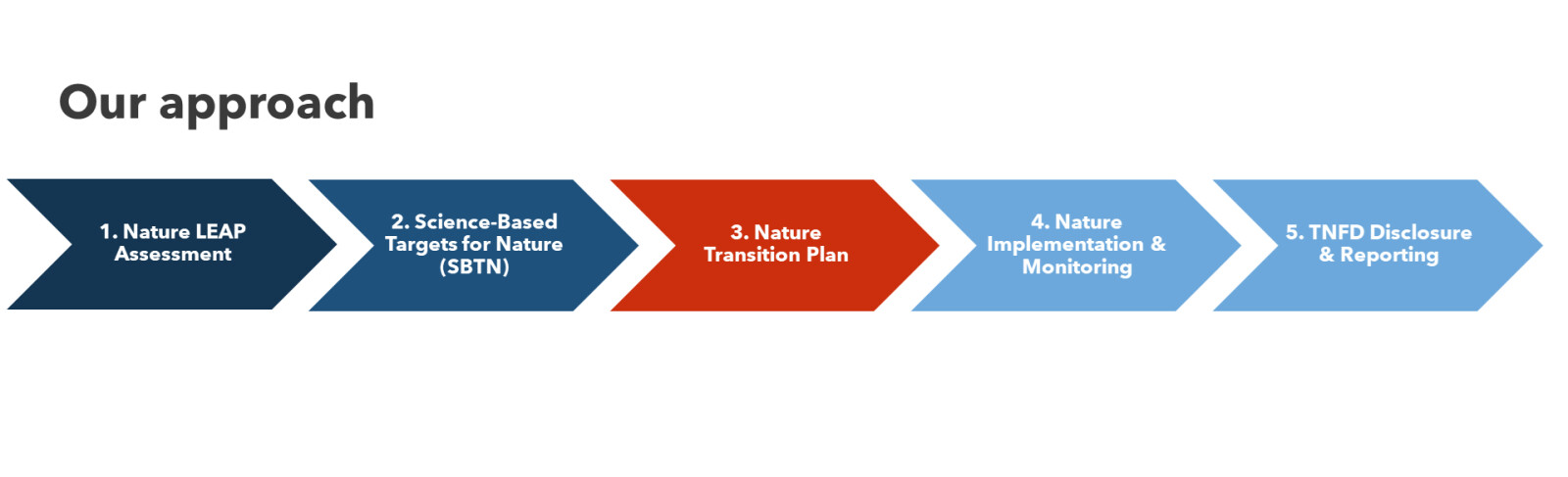
1. Nature LEAP Assessment
When starting the transition of integrating nature in your organisation's decision making, you first need to understand how your activities impact nature and vice versa through a LEAP (Locate, Evaluate, Assess and Prepare) assessment. With a LEAP assessment we help you to identify how and where your organisation interacts with nature across your operations and value chain. We then determine which locations, value-chain segments, and environmental pressures are most significant and warrant deeper analysis. These impacts and dependencies are translated into concrete business risks such as physical, regulatory, reputational, and legal risks, as well as potential opportunities, including nature-positive products and supply resilience. Together, we prioritize and quantify these insights where possible, and integrate the outcomes into decision-making processes, informing mitigation actions, strategy updates, policies, KPIs, board reporting, procurement criteria, and capital allocation.
2. The Science Based Targets for nature (SBTN)
The Science Based Targets Network (SBTN) is a collaboration of scientists and sustainability experts from over 80 leading organizations. It provides a framework for developing measurable corporate targets on nature and builds upon climate action.
Through SBTN’s five-step process, organizations assess their contributions to key environmental pressures, including water and land. With 2impact as a reliable partner, we support organisations in applying SBTN guidance, translating assessments into actionable targets, and embedding them into strategy and reporting for a nature-positive impact.
3. Nature Transition Plan
After assessing your nature related dependencies, impacts, risk and opportunities and setting targets, it is important to create a strategic roadmap for how you are going to reach your ambition and targets. A nature transition plan outlines how an organisation will adapt its operations, value chains, and business model to align with the Global Biodiversity Framework where biodiversity loss is halted and reversed by 2030 to put nature on a path to recovery by 2050.
We will engage your team to conduct a thorough assessment of your dependencies, impacts risks and opportunities and define clear pathways of reducing dependencies and impact and seize opportunities. Whether it is developing nature-based solutions, protecting ecosystems or applying the mitigation hierarchy, we provide the expertise and resources needed to craft a plan that is both ambitious and achievable.
A robust nature transition plan is often guided by frameworks like the TNFD and Science Based Targets Nature (SBTN) and includes measurable targets, governance structures, and mechanisms to track progress over time.
4. Nature Implementation & Monitoring
Once your nature strategy and targets are defined, the next step is effective implementation. We support your organisation in translating ambitions into concrete actions and embedding them into daily operations.
We work with your teams to integrate nature-related measures into governance structures, procurement processes, risk management and internal reporting. At the same time, we help establish monitoring systems to track progress against defined targets and KPIs, ensuring that performance can be measured and adjusted where necessary.
5. TNFD Disclosure & Reporting
The TNFD provides a global framework designed to help organisations identify, report on, and act upon nature-related risks and opportunities. Its goal is to shift financial flows toward nature-positive outcomes and to support better decision-making by integrating nature into corporate strategy, risk management, and financial planning. The framework encourages transparent disclosure across four key pillars: governance, strategy, risk management, and metrics and targets.
Together we will set ambitions for your nature reporting. We will guide and advice you during the preparation of your report – from breaking down the reporting requirements into plain language to organising your data in a way that makes sense to drafting the text. We collaborate with your team throughout the report creation process.
We also work together with software and design partners, so we can help ensure every aspect of the report is fully managed.
Additional services
Beyond our core services, we recognise that every organization interacts with nature in its own unique way. That’s why we tailor our support to your specific challenges, industry context, and level of maturity. We stay closely aligned with evolving regulations and international standards such as the EU biodiversity strategy, EUDR or the Omgevingswet, so you can be confident that our guidance reflects the latest requirements. As your personal and trustworthy partner, we provide broader nature-related support, including assistance with standards like ISO 17298 and other emerging frameworks.
-nl-en-en.webp)